The Abbey of Holy Trinity
The Abbey of Holy Trnity Is the largest monastery complex in Basilicata region.
It is divided in the so- called “ancient church” (chiesa vecchia) and the "Ufinished", Incompuita in italian. The oldest part of the ancient church dates back to Paleo- Christian period. Inside there are some beautiful mosaics and frescos from different periods (XI- XVII century).
In the right nave there is the sepulchre of Robert the Hauteville (aka. Robert the Guiscard, as a very clever person) and his brothers, Normands coming from North Europe.
In the left nave you can see The marbre sepulcher of Aberada di Buonalbergo, Robert Guiscard’s first wife. She was the daughter of Reginald I, Count of Burgundy who wanted the support of the rising Guiscard at that moment.
As her dowry, she brought Robert Guiscard, two hundred knights. She bore Guiscard two children: a daughter, Emma, mother of Tancred, Prince of Galilee, and a son, Prince Bohemond I of Antioch. In 1058 Guiscard repudiated Alberada in favour of a then-more advantageous marriage to Sichelgaita of Salerno. Nevertheless, the split was amicable and Alberada showed no later ill will. Her tomb is the only one remaining intact today. On the top you can see the motto in latin:
«GVISCARDI CONIVX ABERADA HAC CONDITVR ARCA / SI GENITVM QVÆRES HVNC CANVSINVS HABET»
« Aberada, Guiscardo’s wife, lie in this sarcophagus. If you are looking for his son, Canosa has him».
So, you can take a visit to Canosa di Puglia to see the Mausoleum of Bohemond, near the cathedral of Saint Sabino. Bohemond was one of the leaders of the First Crusade, who conquered Antioch.
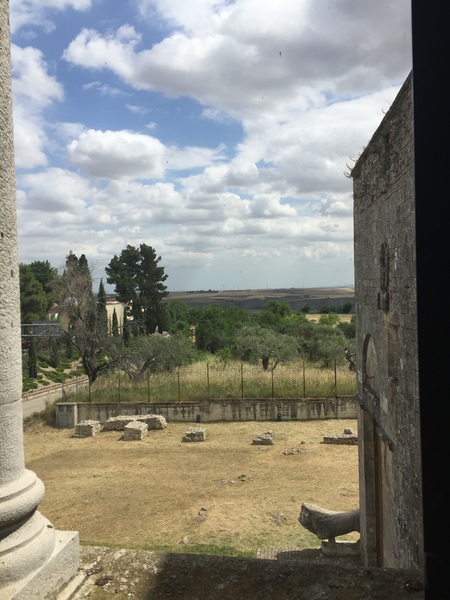
From the Archeological Park you can visit the Unfinished, “new church”.
This was the great project of Robert the Guiscard: a magnificent abbey directly inspired by franco- normand churches as Cluny Abbey in France.
The abbot Berengario come from a normand monastery. The project was ambitious and expensive, and with the death of the norman crusader in 1085, the construction was left incomplete.
You enter through a graven portal with the symbol of the riders of Malta, fosters of this place during 17th century.
The Incompiuta was built with stones, decorations and material coming from the near roman site. It was a practice widely spread in the Middle Ages, the reuse of old materials.
About the architecture:
· The internal layout forms a latin cross with three naves and a transept
· You can see three Radial Chapels, typical of franco- normand abbeys
· The sky is the vault of the church
You can observe
· Roman and Lombard inscriptions, but also jewish inscriptions that shows that during roman period there was a big Hebrew community, who lived in harmony with Christians.
The continuity between the perfectly finished old curch and the Incompiuta creates a striking transition from the physical to the metaphysical, from the finite to the finite…
A timeless and magical place...



Erstellen Sie Ihre eigenen Audio-Touren!
Die Verwendung des Systems und der mobilen Stadtführer-App ist kostenlos.
