Tur audio Brindisi: a welcoming city for thousands of years.
6 obiective turistice
- Sumar tur audio
-
Sumar tur audio
Update Required To play the media you will need to either update your browser to a recent version or update your Flash plugin.There are many legends about the foundation of Brindisi. The most beautiful of which is the story of the mythical Brento, son of Eracle (Hercules) , who shaped the city in his own image: the two branches of the harbor on his arms, the peninsula between them on his head and the middle port on his body.I Itis from the amazing and unique natural harbor, and its privileged geographical position, that every story proceeds. The port was inhabited since the prehistoric era, as testified by the archaeological finds which date back to at least 12.000 years ago. It started commercial exchanges during the intermediate Bronze age, when Mycenaeans settled, interested in its strategic position for their traffics. The foundation of the city, in VIII century BC, is due to Messapians who renamed it as Brenton, i.e. ‘head of deer’ because of the particular shape of its harbor. However it was after the Roman conquest, and the foundation of the colony of Brundisium in 244 BC that the city had a long period of social and economic development, which made it an irreplaceable commercial hub for trades with the opposite shore, as well as the starting point of the Roman expansion. After the fall of the Roman empire, the commercial vocation of the port attracted several people, such as Normans, Swabians, Angevins, Aragoneses, Bourbons and Austrians. Until, with the opening of the Suez channel it became the European terminal of the Imperial Indian Mail and the port of shipment of the main communication route between western Europe and the East. Currently the city, besides its industrial activity, preserves its connection with the sea and it is one of the most frequently chosen port for those who travel to Greece and Albany.
This itinerary is meant as a suggestion, since it describes only few of the beauties of our city.
This audio guide is edited by Associazione le Colonne as leading body of the cultural integrated system 'Past'.
Translation and voice: Sandra Francioso
Text: Daniela La Fauci
Photo credits: Domenico Summa, Daniela La Fauci, Fabio Greco, Maurizio De Virgiliis, Roberto Romeo, Serena Garganese
- 1 Belvedere Building - Faldetta Archaeological Collection
- 2 Virgil staircase - Roman columns
- 3 Granafei-Nervegna Palace - Capital Hall
- 4 S. Pietro degli schiavoni archaeological area
- 5 Temple of Saint John at the sepulcher.
- 6 The monument to the italian sailor
-
Sumar tur audio
Update Required To play the media you will need to either update your browser to a recent version or update your Flash plugin.There are many legends about the foundation of Brindisi. The most beautiful of which is the story of the mythical Brento, son of Eracle (Hercules) , who shaped the city in his own image: the two branches of the harbor on his arms, the peninsula between them on his head and the middle port on his body.I Itis from the amazing and unique natural harbor, and its privileged geographical position, that every story proceeds. The port was inhabited since the prehistoric era, as testified by the archaeological finds which date back to at least 12.000 years ago. It started commercial exchanges during the intermediate Bronze age, when Mycenaeans settled, interested in its strategic position for their traffics. The foundation of the city, in VIII century BC, is due to Messapians who renamed it as Brenton, i.e. ‘head of deer’ because of the particular shape of its harbor. However it was after the Roman conquest, and the foundation of the colony of Brundisium in 244 BC that the city had a long period of social and economic development, which made it an irreplaceable commercial hub for trades with the opposite shore, as well as the starting point of the Roman expansion. After the fall of the Roman empire, the commercial vocation of the port attracted several people, such as Normans, Swabians, Angevins, Aragoneses, Bourbons and Austrians. Until, with the opening of the Suez channel it became the European terminal of the Imperial Indian Mail and the port of shipment of the main communication route between western Europe and the East. Currently the city, besides its industrial activity, preserves its connection with the sea and it is one of the most frequently chosen port for those who travel to Greece and Albany.
This itinerary is meant as a suggestion, since it describes only few of the beauties of our city.
This audio guide is edited by Associazione le Colonne as leading body of the cultural integrated system 'Past'.
Translation and voice: Sandra Francioso
Text: Daniela La Fauci
Photo credits: Domenico Summa, Daniela La Fauci, Fabio Greco, Maurizio De Virgiliis, Roberto Romeo, Serena Garganese
Recenzii
Descărcați aplicația gratuită izi.TRAVEL
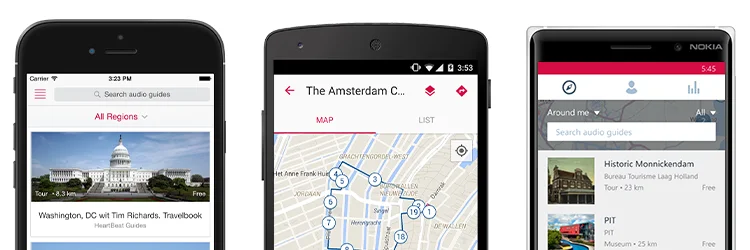
Creați-vă propriile tururi audio!
Folosirea sistemului şi a aplicaţiei ghid mobile este gratuită